
Dr Cameron West is talking about time spent in London.
With his glamorous wife Rikki by his side, he describes multiple trips to see their musician son play with the London Symphony Orchestra, the London Philharmonic and as principal bassist for the world-famous violinist, Nigel Kennedy.
West, 71, happily reminisces about living in Kensington; frequenting the fish market in Islington; meandering through Notting Hill.
Rikki, 72, beams at the memories.
Married for 45 years, the gregarious and affectionate couple with dazzling smiles, now based in California, are a vision of health, contentment and a life well lived.
But then West’s jaw begins twitching and his eyes dart from side to side.
‘The “alters” tend to come when there is a leakage that happens,’ he explains. ‘Like now.’
Rikki places a protective arm around her husband’s shoulders and a hand on his chest. She knows what is coming.
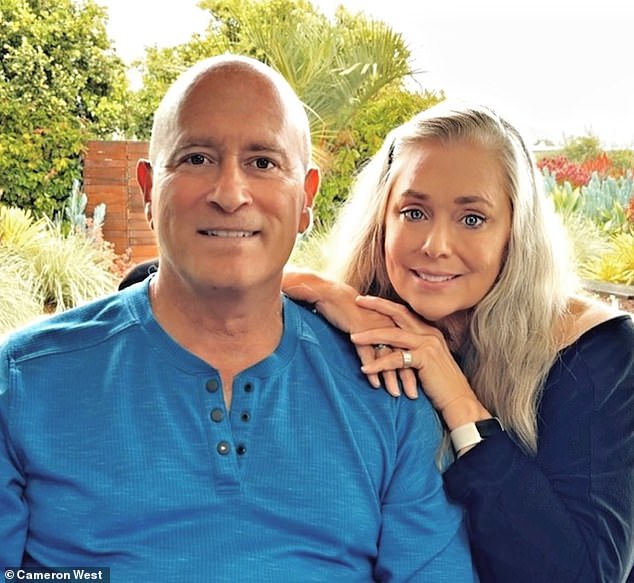
West’s face contorts and he asks, in a high-pitched voice: ‘Who’s that lady?’
With perfect composure Rikki explains: ‘This is Clay.’
Clay is one of dozens of ‘alters’ that populate her husband’s mind — a shy and often stuttering eight-year-old boy, who struggles to make eye contact and, it turns out, loves Reese’s peanut butter cups, while West doesn’t eat sugar.
This is the strange and, to an observer, disorienting reality of West and Rikki’s everyday life.
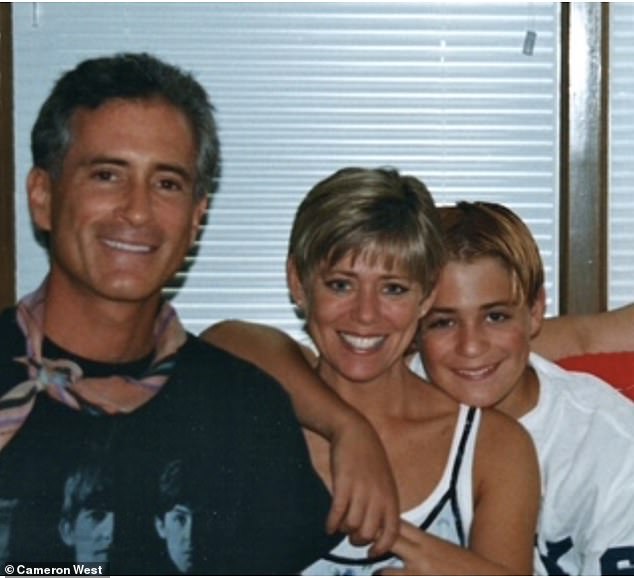
West was 36 when he was diagnosed with Dissociative Identity Disorder (DID), previously called multiple personality disorder. He had been married for ten years and was father to a five-year-old boy.
Decades of therapy and hospitalizations followed as West and Rikki learned how to live with his situation.
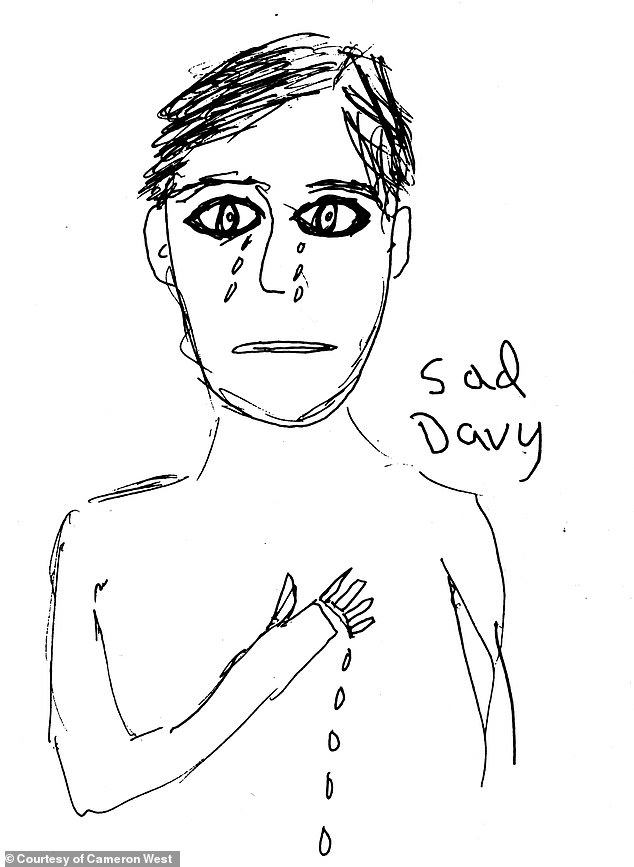
Now West’s psyche is generally calm, with many of the alters — at one point there were 24, each with their own names and identity, like Clay and ‘Sad Davy’ — receding or merging.
Clay doesn’t stay long. After only a few moments West pipes up in Clay’s childlike voice: ‘Going to go.’
His face contorts, his head swivels, his eyes dart around and he breathes heavily. It takes West a moment to return to the moment and when he does his first question is: ‘What were you talking about?’
This week West and Rikki have reissued their memoir First Person Plural.
Written more than 25 years ago, the book covered the three years from West’s initial terrifying symptoms and has been republished to update readers on the decades since.
When it first came out, in 1999, the book was a sensation. Oprah Winfrey invited them onto her show and they grew close to Robin Williams when he was hoping to turn it into a film. Disney still own the rights.
The couple’s decision to reissue the book was, they say, driven by a desire to bring their story to a new audience, spread the word that the condition exists and let people know there is hope.
‘We used to get thousands of emails from people saying, “Where can I find a therapist? My therapist has no idea what this is,”’ says Rikki.
She says: ‘People are misdiagnosed, underdiagnosed, so part of what we’re hoping — again, as we did then — is that it brings it to light and gets people talking about it again. Hopefully it allows clinicians to revisit it and permits people who think they have it, or who do have it, to maybe get involved in some treatment.’
There are no drugs to treat DID specifically, but the symptoms that come with it — depression, anxiety, suicidal thoughts — can be alleviated. Intense therapy is the only way forward.
Rikki says: ‘You can heal from it.’
West nods. ‘What can I say? I’m just the living proof. I’m hard to kill.’
He laughs, but there is no shying away from the horrors described in the memoir.
Born in Chicago, West was sexually abused by his grandmother when he was a toddler. She died when he was around four and a half.
He was also sexually abused by his own mother and raped by an older male relative.
For decades, West had no knowledge of this — the memories repressed.
He graduated from the State University of New York with a degree in business and music, toured as a musician and met Rikki in Boston in 1978.
They married in 1981 and moved to Nashville for West to work as a musician and Rikki to practice child psychology.
When their son was born West, not wanting to be on the road, quit the music industry and the trio moved to New England, so West could work with his brother at their advertising merchandise company.
Their life felt normal — happy.
But West began to have sinus issues, requiring multiple operations. Being close once more to his mother, who also lived in New England and wanted to spend time with her grandson, was, he now believes, another trigger for what was to come.
The veneer of ‘normality’ was cracking under the strain of repressed secrets. A dam was about to burst.
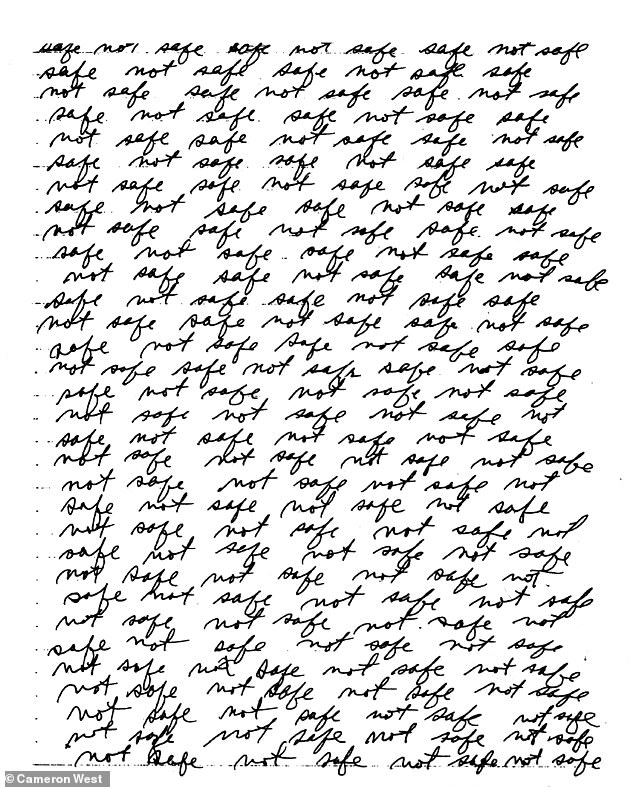
West writes in vivid detail about finding himself speaking gibberish, sitting in the snow in the parking lot of a strip mall, wondering who he was. He awoke one night and scribbled seven pages in a notebook — the words, ‘Safe, not safe,’ repeated.
West found a therapist in a phone book and told her: ‘Something is very wrong with me. I think I lost my soul.’
Remarkably, the therapist had treated DID sufferers before. The condition, she told West, is far more common than people think: an estimated 1.5 percent of the population have been diagnosed with it, which means it affects 5.2 million Americans.
The therapist asked West about his childhood, which initially he could not recall at all. Slowly, the memories, and the horror, came back to him — as did the ‘alters’ who had contained the past.
One was a young girl, who had been raped. One was a destructive and angry being, who self-harmed and drew images in blood, sending West several times to the hospital and in-patient psychiatric care.
Another was an older, calmer character, who Rikki would sometimes ask to talk to in the midst of the chaos.
Together she and West learnt to ask the alters to return to ‘the comfort room’ in West’s mind and let West be wholly present.
It’s an astonishing saga.
West repeatedly, adoringly, says he would not have made it through without Rikki’s support.
She calmly tried to understand his predicament, supporting and protecting their son and even confronting her husband’s Gucci-clad mother, who turned on her stiletto and marched out the door, never to see them again.
Rikki relocated the family to California in 1994, to put some distance from the trauma and start afresh. When West was unable to work, she took on multiple jobs and supported him as he studied for a PhD in psychology.
‘The question I’m often asked is, “How did you stay?” How did you not go run screaming into the night?’
Rikki West‘But, you know, I never for a second really considered abandoning Cam. I was totally committed to helping him heal and, as he said, to keeping our family together.
‘Cam was so incredibly brave, because there were times when he wanted to do himself harm and disappear, because the pain of sexual abuse is horrendous, the internal pain and how it makes you feel.’
West, Rikki recalled, had ‘some really, really dark times,’ and she viewed it as her job to help him and help their young son understand what was going on — as much as a child ever could.
It helped that she had training in dealing with trauma-related conditions and knew how to ‘stay steady’ when chaos was all around. It also helped that she had a therapist of her own and good friends.
But, for the most part, the couple kept what they were going through to themselves, not even telling their neighbors until the book was published. When they did, they were surprised by the reactions they got.
‘People were so supportive,’ said Rikki. ‘I thought, why wasn’t I just open? And I think that’s a difference now, compared to 25 years ago. Mental health is more out in the open.’
Both describe their decades of dealing with the condition as being extremely lonely.
West writes poignantly of attending his first group therapy session and being stunned to realize there were people just like him out there.
At times, he told himself he was ‘just nuts,’ denying that he suffered from DID. But during one stint in a psychiatric ward the doctors filmed his very physical transitions between ‘alters.’ Watching back the footage finally convinced West his condition was real.

At one point the couple was even invited by a Japanese television network to participate in an experiment where, for the first time, a DID patient’s brainwaves were scanned as the different ‘alters’ came and went.
The scientists saw that West’s brain would register adult brainwaves and then a pattern like a seizure while transitioning into a child ‘alter,’ which registered brainwaves more akin to a young person’s.
‘It was fascinating,’ said Rikki. ‘An actor could portray West’s switching, but they couldn’t change their brain waves like that. So perhaps there’s value in that for people who are still doubters, maybe? To see the physiological proof.’
West and Rikki now spend their time writing together. Their latest work, The Remarkable Mind(s) of Bo Sender, is a novel about a 16-year-old girl who, like West, is a ‘multiple.’
Rikki says, ‘We have a unique ability to speak with authenticity and to lend that voice to someone so that the experience of that character is from the inside.’
To this day people are often surprised when West tells them about the myriad of alters who exist within him.
‘I’m so goddamn good at seeming normal,’ he writes.
When he tells people about his DID diagnosis, the response is often the same, he says. The first question they ask is, ‘Who am I talking to?’
Is that offensive to him or is it helpful?
West shrugs: ‘People are curious. Some are afraid.
‘But then I reply, “It’s me. Hey, man, it’s me.”’